
Documentation Index

Fetch the complete documentation index at: https://inference-docs.cerebras.ai/llms.txt

Use this file to discover all available pages before exploring further.

What is Braintrust?

Braintrust is the AI observability platform helping teams measure, evaluate, and improve AI in production. Learn more at https://www.braintrust.dev/

Prerequisites

Before you begin, ensure you have:
  • Cerebras API Key - Get a free API key here.
  • Braintrust API Key - Visit Braintrust and create an account or log in.
    • Go to Settings > AI Providers and add your Cerebras API key. Then generate a Braintrust API key.
  • Python 3.7 or higher

Configure Braintrust

1

Install required dependencies

Run the following:
pip install autoevals braintrust openai
2

Configure environment variables

Create a .env file in your project directory:
CEREBRAS_API_KEY=your-cerebras-api-key-here
BRAINTRUST_API_KEY=your-braintrust-api-key-here

# Optional: If self-hosting Braintrust
# BRAINTRUST_API_URL=your-braintrust-api-url
3

Initialize the client

Set up the Cerebras client with Braintrust wrapping:
import os
import openai
import braintrust

# Wrap the OpenAI client to enable automatic tracing
client = braintrust.wrap_openai(
    openai.OpenAI(
        api_key=os.getenv("CEREBRAS_API_KEY"),
        base_url="https://api.cerebras.ai/v1",
        default_headers={"X-Cerebras-3rd-Party-Integration": "braintrust"}
    )
)
4

Start logging

Initialize a logger to automatically track all your model calls:
  import os
  import openai
  import braintrust

  # Wrap the OpenAI client to enable automatic tracing
  client = braintrust.wrap_openai(
      openai.OpenAI(
          api_key=os.getenv("CEREBRAS_API_KEY"),
          base_url="https://api.cerebras.ai/v1",
          default_headers={"X-Cerebras-3rd-Party-Integration": "braintrust"}
      )
  )

  # Initialize logger for your project
  braintrust.init_logger("My Cerebras Project")

  # Make a simple completion call
  response = client.chat.completions.create(
      model="llama3.1-8b",
      messages=[
          {"role": "system", "content": "You are a helpful assistant."},
          {"role": "user", "content": "What is the capital of Nevada?"},
      ],
      extra_headers={
          "X-Cerebras-3rd-Party-Integration": "braintrust"
      }
  )

  print(response.choices[0].message.content)
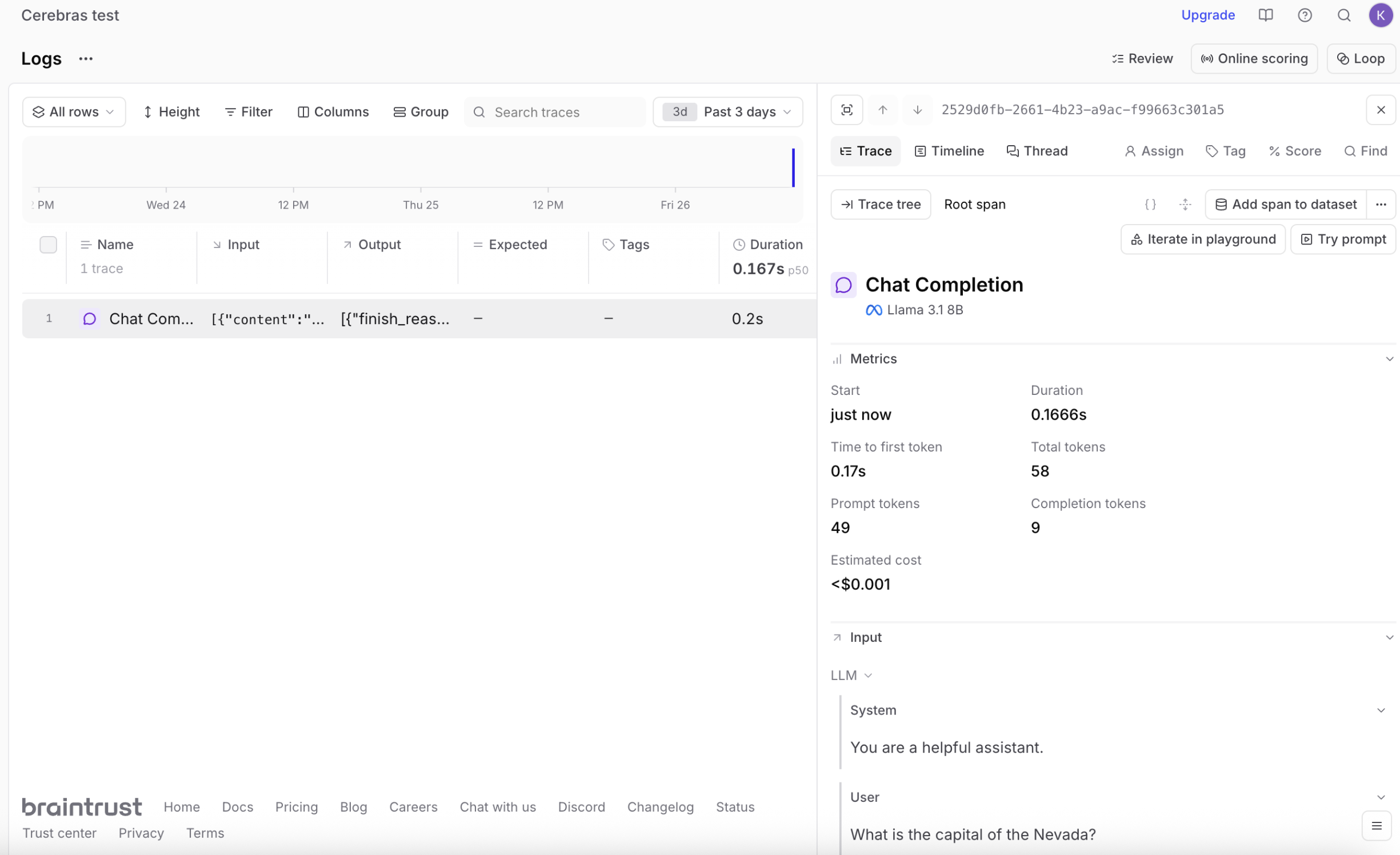
All calls are automatically logged to Braintrust with metrics like latency, token usage, and time to first token.
5

View your logs

  • Open the Braintrust dashboard
  • Navigate to your project
  • View detailed logs with metrics
  • Reproduce and tweak prompts directly in the UI view logs tweak the prompt
6

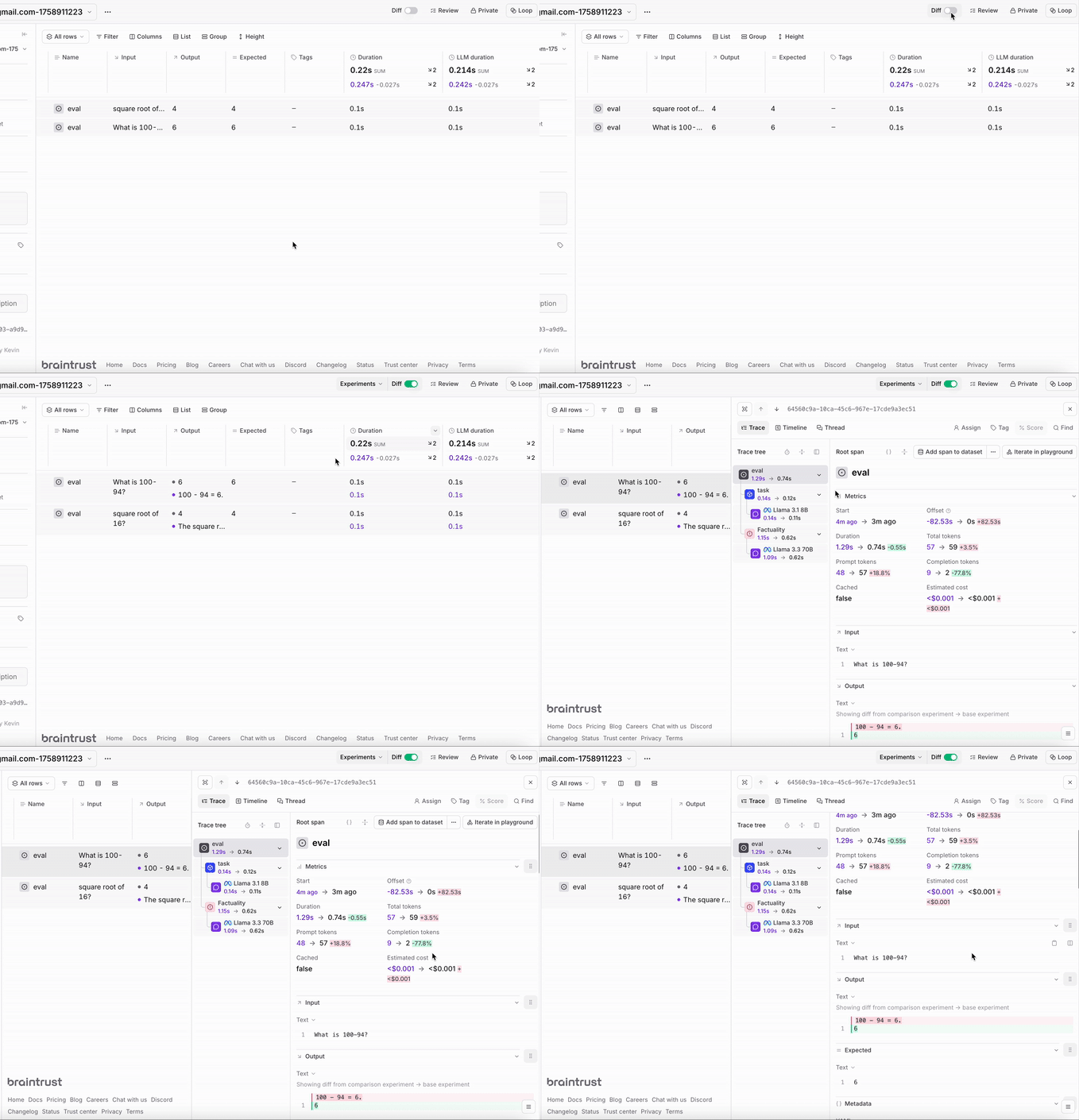
Run evaluations

Create evaluations to test your model’s performance:
  import os
  import openai
  from braintrust import wrap_openai, Eval
  from autoevals import Factuality

  # Wrap the OpenAI client to enable automatic tracing
  client = wrap_openai(
      openai.OpenAI(
          api_key=os.getenv("CEREBRAS_API_KEY"),
          base_url="https://api.cerebras.ai/v1",
          default_headers={"X-Cerebras-3rd-Party-Integration": "braintrust"}
      )
  )

  Eval(
      "My Cerebras Project",
      data=[
          {"input": "What is 100-94?", "expected": "6"},
          {"input": "What is the square root of 16?", "expected": "4"},
      ],
      task=lambda input: client.chat.completions.create(
          model="llama3.1-8b",
          messages=[
              {
                  "role": "system",
                  "content": "You are a helpful assistant. Provide only the answer.",
              },
              {"role": "user", "content": input},
          ],
      ).choices[0].message.content,
      scores=[
          Factuality(
              model="gpt-oss-120b",
              api_key=os.environ["CEREBRAS_API_KEY"]
          )
      ],
  )
You can check these evaluations in the Braintrust dashboard:dashboard
Available Models

Cerebras offers several high-performance models for your Braintrust evaluations:
ModelParametersBest For
llama3.1-8b8BFastest option for simple tasks and high-throughput scenarios
gpt-oss-120b120BLargest model for the most demanding tasks
zai-glm-4.7357BAdvanced 357B parameter model with strong reasoning capabilities
Simply change the model parameter in your API calls to switch between models.

Next Steps

  • Explore the Braintrust documentation
  • Migrate to GLM4.7: Ready to upgrade? Follow our migration guide to start using our latest model
  • Try out different Cerebras models
  • Set up custom evaluation metrics
  • Build production monitoring dashboards

Troubleshooting

API Key Issues

  • Verify your keys are correctly set in environment variables
  • Check that Cerebras key is added to Braintrust’s AI providers

Import Errors

  • Ensure all packages are installed: pip install autoevals braintrust openai
  • Use a virtual environment to avoid conflicts

Connection Issues